
Development
The STIHL Group is continuously advancing research and development to achieve dual technology leadership – especially with regard to battery technology. This ambition was underscored in 2025, with the market release of more than 35 new developments and optimizations. As well as performance improvement, we are also focused on the sustainability of our products.
Future-oriented technologies with high standards
The Group is pursuing a dual approach as it targets dual technology leadership: While battery-powered tools predominate in urban areas, the demand for high-performance gasoline-driven products still remains – especially in the professional segment. We are continually shifting this boundary with new products and technologies, enabling even higher-performance battery products.
Battery Power
One example is the STIHL FSA 400 – the most powerful battery clearing saw in the range, with two kilowatts of mechanical power. It has a mowing diameter of 520 millimeters and features an anti-vibration system as well as bike handlebars. The STIHL FSA 400 is compatible with the entire AP system.

The AP system has been further optimized in 2025 with the AP 500 S battery pack: In addition to an increased output of 3,500 watts, the charging time when using a fast charger has been reduced to 35 minutes on average.
The new STIHL TSA 500 and TSA 300 cut-off machines are both powered with the AP system and are equipped with an innovative power-boost function that provides the maximum possible power for the respective application.
Blowers with high energy requirements are also powered with the AP system; the new STIHL BRA 600 with 35 newtons of blowing force is just one of the 2025 innovations.
The STIHL SBA 140 is the first battery-powered berry harvester from STIHL. It increases efficiency when harvesting berries or other small fruits and offers three adjustable speed levels.
To ensure reliable charging, the STIHL AL 1802 MO fast charger was developed. It charges two AP system batteries at high speed, is splash-proof, and is suitable for use in workshops, vehicles, or outdoors.
Alternative fuels
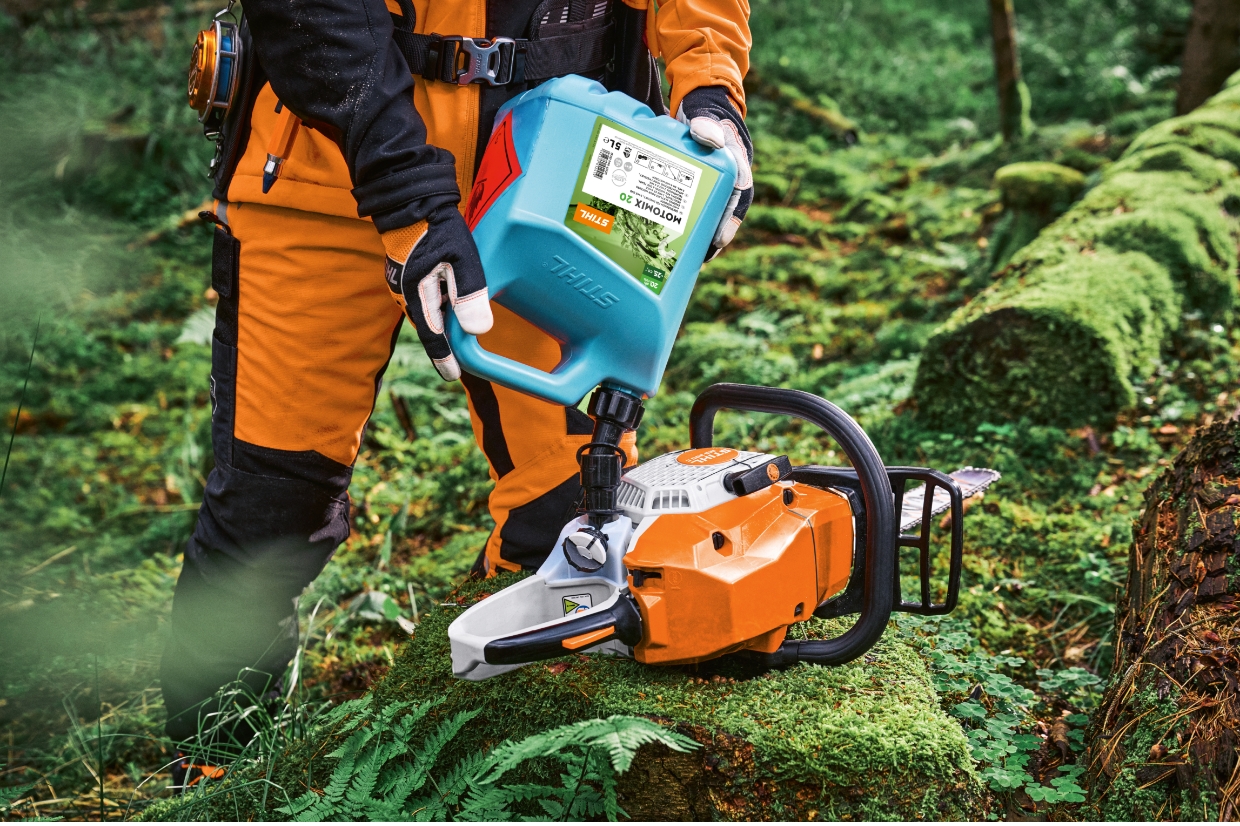
The STIHL Group is also optimizing sustainability and performance in products with combustion engines. Since the majority of greenhouse gas (GHG) emissions are generated during use, alternative fuels are increasingly coming into focus. A new special fuel was introduced in 2025: MotoMix 20. It consists of 20 percent biogenic raw materials1. The more cleanly burning alkylate formulation produces more water and less CO2 during combustion; in combination with the biogenic components, the result is a fuel with at least 25 percent2 lower GHG emissions than fossil fuels. A further advantage is that with MotoMix 20, GHG savings can be achieved even in the existing tools.
The integration of e-fuels offers significantly more long-term GHG reduction potential, including through the use of CO2 available in the air in e-fuel production. When looking at the manufacturing and usage phase as a whole, GHG savings of up to 90 percent are possible. This means products powered by e-fuels would have lower CO2 emissions than current battery-powered products.
- Advanced biofuel in accordance with Annex IX, Renewable Energy Directive (RED, Directive (EU) 2018/2001).
- Compared to the fossil reference value for gasoline in the use phase, 73.4 g CO2e/MJ (Directive (EU) 2018/2001).
Top performance for forestry
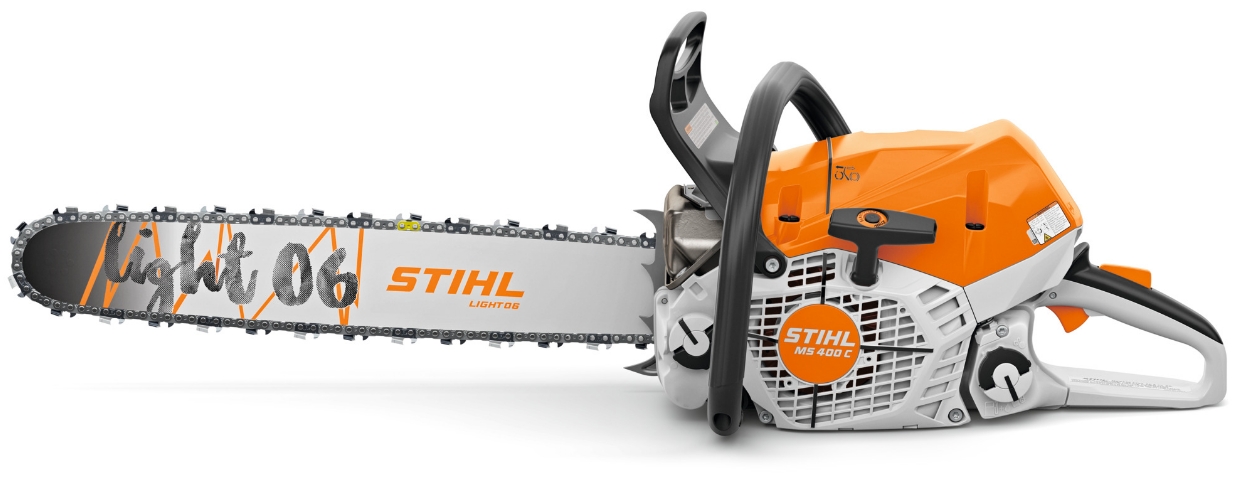
The STIHL MS 400 C-M sets a new benchmark in the 60 cm3 class. At 3.9 kilowatts and 5.5 kilograms, this chainsaw for professionals and demanding private users has the best power-to-weight ratio in the 60 cm3 class. It also delivers very high torque at low engine speeds, low gyro forces, and outstanding acceleration. This output is made possible by STIHL M-Tronic engine control and the advanced machine topology.
Widely distributed new products
In 2025, STIHL also shaped the market with innovations in other customer segments. The compact GTA 30 battery garden pruner makes pruning work in the garden easier thanks to automatic chain tensioning, ergonomic design, and high cutting efficiency. The RMA 453 lawn mower raises the bar thanks to its dual-battery slot for long operating times and exceptional user-friendliness. The SEA 50 L battery wet and dry vacuum cleaner makes an impact with its compact, portable design and also meets the expected requirements for use in workshops.